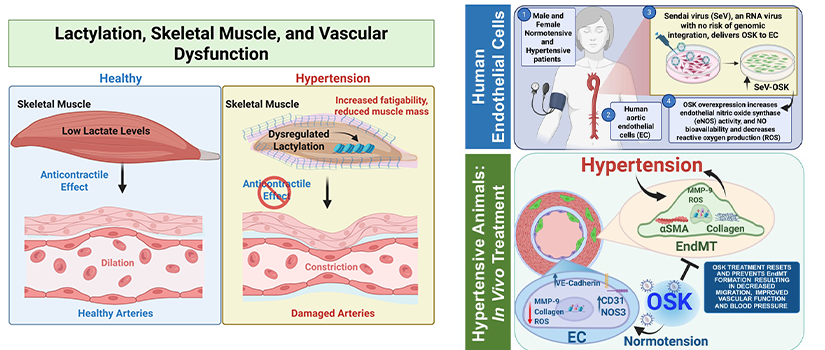
New research shows that the way our muscles use energy is closely connected to how well our blood vessels work, especially in people with high blood pressure. High levels of lactate—a chemical made when muscles burn energy—often appear before high blood pressure begins, and people with less muscle tend to have more lactate. To study this, scientists examined normal rats and rats that naturally develop high blood pressure. They measured muscle strength and tiredness, tested how well leg arteries tightened and relaxed, checked lactate levels in blood and muscle, and looked at muscle structure and mitochondria. They also studied how lactate changes certain proteins and compared their findings to human muscle data.
Rats with high blood pressure had weaker muscles, got tired faster, had smaller muscle size, and showed poor mitochondrial function. Their muscles also built up too much lactate, even though some energy‑related markers increased, suggesting their metabolism wasn’t working normally. Important muscle and energy‑related proteins showed changes linked to lactate. These rats also lost the normal support that muscle gives to nearby arteries, and their arteries didn’t relax as well. Human data showed similar changes. Overall, high blood pressure disrupts how muscles use energy and how muscles and blood vessels communicate, and too much lactate appears to play a major role. Understanding these lactate‑related changes may help lead to new treatments for blood vessel problems in people with high blood pressure.
|
|
Hypertension Drives Protein Lactylation and Vascular Dysfunction in Skeletal Muscle. Fontes MT, Townsend P, Butler L, Parente JM, Araujo FA, Costa TJ, Bomfim GF, Pernomian L, Tan W, VanderVeen BN, Murphy EA, Stark RJ, Butcher JT, McCarthy CG, Wenceslau CF. Hypertension. IMPACT FACTOR: 8.2 2026 Apr 22:10.1161/HYPERTENSIONAHA.125.25665. doi: 10.1161/HYPERTENSIONAHA.125.25665. Online ahead of print. PMID: 42017232 |
|
|
Single-Short Partial Reprogramming of the Endothelial Cells Decreases Blood Pressure via Attenuation of EndMT in Hypertensive Mice. Pernomian L, Waigi EW, Nguyen V, Mohammed AD, Costa TJ, Fontes MT, Kubinak JL, Aitken AV, Biancardi VC, Gleason K, Shazly T, Sinclair DA, McCarthy CG, Wang Y, Tan W, Wenceslau CF. Circ Res. 2025 Sep 26;137(8):1092–1113. |