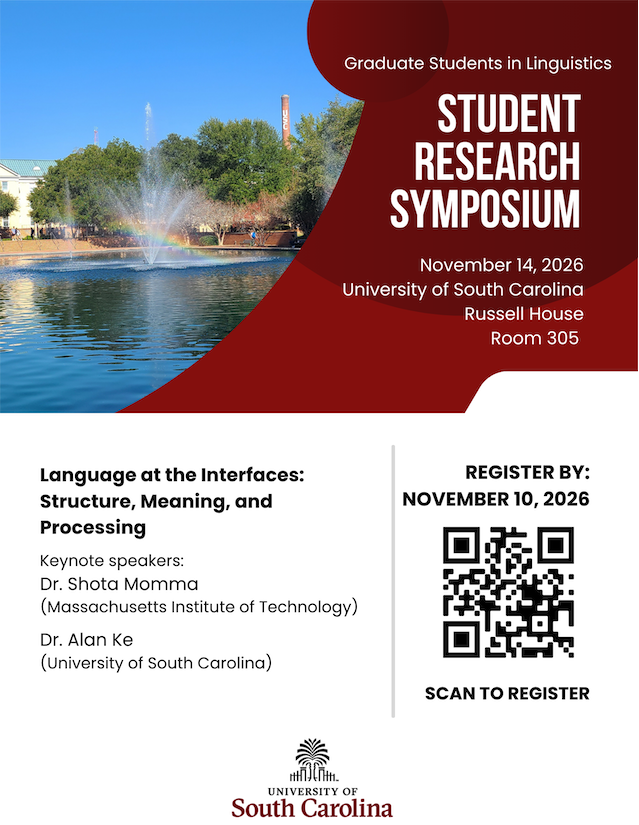
The Graduate Students of Linguistics (GSLING) at the University of South Carolina are hosting the Fall 2026 Student Research Symposium (SRS) on Saturday, November 14th, 2026. TThis year’s theme is “Language at the Interfaces: Structure, Meaning, and Processing.
To attend this symposium, please register by November 10th, 2026. Follow this link to register or scan the QR code in the flyer. Registration on site will also be available on the day of the event on Saturday, November 15th, 2025. There is no registration fee for the conference.
Date: Saturday, November 14th, 9:00am - 5:00pm.
Location: University of South Carolina, Russel House rooms 304 & 305
Contact: for inquiries please contact Ekaterina Ausheva (eausheva@email.sc.edu)
SRS provides an excellent opportunity for graduate and undergraduate students to share research in a collaborative setting with colleagues in language-related disciplines, including but not limited to, linguistics, anthropology, education, psychology, and philosophy.
|
|
||
|
I am an associate professor of linguistics at the Massachusetts Institute of Technology (MIT). Before joining MIT, I received my PhD in linguistics from the University of Maryland, College Park, worked as an assistant professor of linguistics at UMass Amherst, and was a postdoctoral researcher in psychology at UC San Diego. Broadly, I study psycholinguistics, the field that investigates how people acquire, understand, and produce language. My research focuses especially on how speakers construct sentence structures while speaking. I am currently interested in whether and how abstract grammatical representations that cannot be easily reduced to the form or meaning of a sentence (such as “A-bar dependencies” in syntax) play a role in sentence production, and how speakers construct these abstract structural representations in real time. |
Alan’s research spans theoretical linguistics, psycholinguistics, and computational linguistics, with a focus on experimental and computational approaches to syntax, language acquisition, and sentence processing. His broader goal is to develop an integrated theory of language acquisition and processing by bringing together insights from these areas. In theoretical linguistics, Alan’s recent work investigates the computational nature of core structure-building and syntactic relation-building operations, including Minimal Search, Form Sequence, Ellipsis, Agree, and Labeling. His research in psycholinguistics and computational linguistics addresses several central questions: (i) What learning algorithms support child language acquisition, and how is linguistic input used by these algorithms? (ii) How is linguistic knowledge affected or lost in older populations, including individuals with Alzheimer’s disease? (iii) How do children develop linguistic knowledge during sentence comprehension, and how do adults apply linguistic knowledge during sentence processing? |